


Kinesis
Embodied AI · Multi-Agent System · Wearable Computing · Adaptive Intervention
An embodied multi-agent system for context-aware posture intervention.
Overview
Kinesis is a multi-agent wearable system that investigates how embodied AI agents might support context-aware behavioral intervention. Using posture correction as a design case, we distribute sensing, contextual understanding, and intervention planning across specialized agents that reason about the body, the moment, and behavioral patterns over time. Together, they form a closed loop that senses bodily state, decides whether and how to intervene, measures the response, and adapts subsequent actions. Kinesis serves as a probe into how multi-agent AI might sense, reason about, and intervene in human behavior—and what this shift means for human agency when AI becomes increasingly embodied with us.
01/Problem
"Posture is not a sensing problem—
but a decision problem."
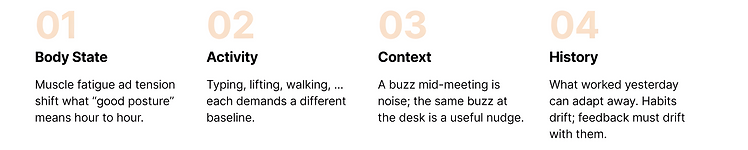
Existing posture systems are increasingly capable of detecting how the body moves. But detecting a deviation does not tell us whether an intervention is appropriate. The same posture can call for different responses depending on what the body is doing, what the person is doing, where they are, and what has worked before.
This led us to a different question: How should an AI system decide whether, when, and how to intervene in the body?
02/Concept
From Detection to Decision
Deciding how to intervene inherently requires reasoning across different kinds of knowledge and different timescales. Bodily signals can reveal what the body is doing, but not whether the moment is appropriate for interruption. Environmental context can explain what is happening now, but not whether an intervention has worked over time. Kinesis therefore distributes these responsibilities across three specialized agents—each reasoning from a different perspective, while contributing to one shared intervention decision.

Three Perspectives, One Intervention
-
Body Agent knows the body. It reads spinal alignment and muscle activity through IMU and EMG.
-
Context Agent knows the moment. It interprets activity, surroundings, and interruptibility through wearable vision.
-
Coach Agent knows the pattern. It integrates body, context, external biometrics, and intervention history across time.

03/System Design
Closing the Loop
Kinesis does not stop after delivering feedback. After each intervention, the system measures the body's response and feeds the outcome back into future decisions. Each cycle teaches the next one. The body is both the target of intervention and the evidence of whether it worked.


Coordinating Decisions in Context
Behind each decision, agents publish their assessments to a shared-state layer. The Coach Agent combines body state, context, external biometrics, and intervention history to authorize, defer, or adapt an intervention.

04/Prototype
Building the Body Agent
To ground agent decisions in the body, we built a back-worn sensing and actuation prototype that combines:
-
2× IMU — spinal deviation
-
3× EMG — muscle activity and fatigue
-
4× vibration motors — localized haptic feedback
-
ESP32 — sensing and actuation control

Making the Intervention Legible
If an AI system can intervene in the body, users should be able to understand why. The interface exposes the system's current body and context assessments, the Coach Agent's intervention decision, and the history of previous actions and outcomes. Rather than treating agent reasoning as invisible infrastructure, we designed the interface as an interpretability layer—allowing users to inspect what the system believes, why it intervened or deferred, and whether the intervention produced a measurable response.
05/ Reflection & Future Work
Extending the Agent Ecosystem
Kinesis is not limited to a single wearable; it is designed as an open agent ecosystem rather than a standalone wearable. Through MCP, external devices can contribute complementary signals—from sleep and recovery to HRV and activity—giving the Coach Agent a richer understanding of the user without coupling every sensor into one system. The architecture stays modular as the embodied context expands.

Where does the AI's agency end—and ours begin?
Kinesis began with a practical question: how can an AI system make more context-sensitive decisions about bodily intervention? But building a system that can continuously sense the body, interpret behavior, and physically intervene surfaced a deeper question: When AI can sense, interpret, and act upon our bodies, where does its agency end—and ours begin? Wearable AI does more than observe us. By deciding when to interrupt, nudge, or remain silent, it can gradually shape how we attend to and regulate our own bodies. As these systems become more embedded, personalized, and autonomous, designing for human agency may require more than giving users an override. It also means asking how AI changes our perception of our bodies, our habits, and ultimately our sense of control over them.
How might embodied AI agents reshape the way we perceive, regulate, and ultimately exercise agency over our own bodies?
Course
MIT AI Studio
Timeline
2026 Spring, 6 weeks
Team
Jiayue Chole Ni
Jianing Nomy Yu
Lilith Yu